

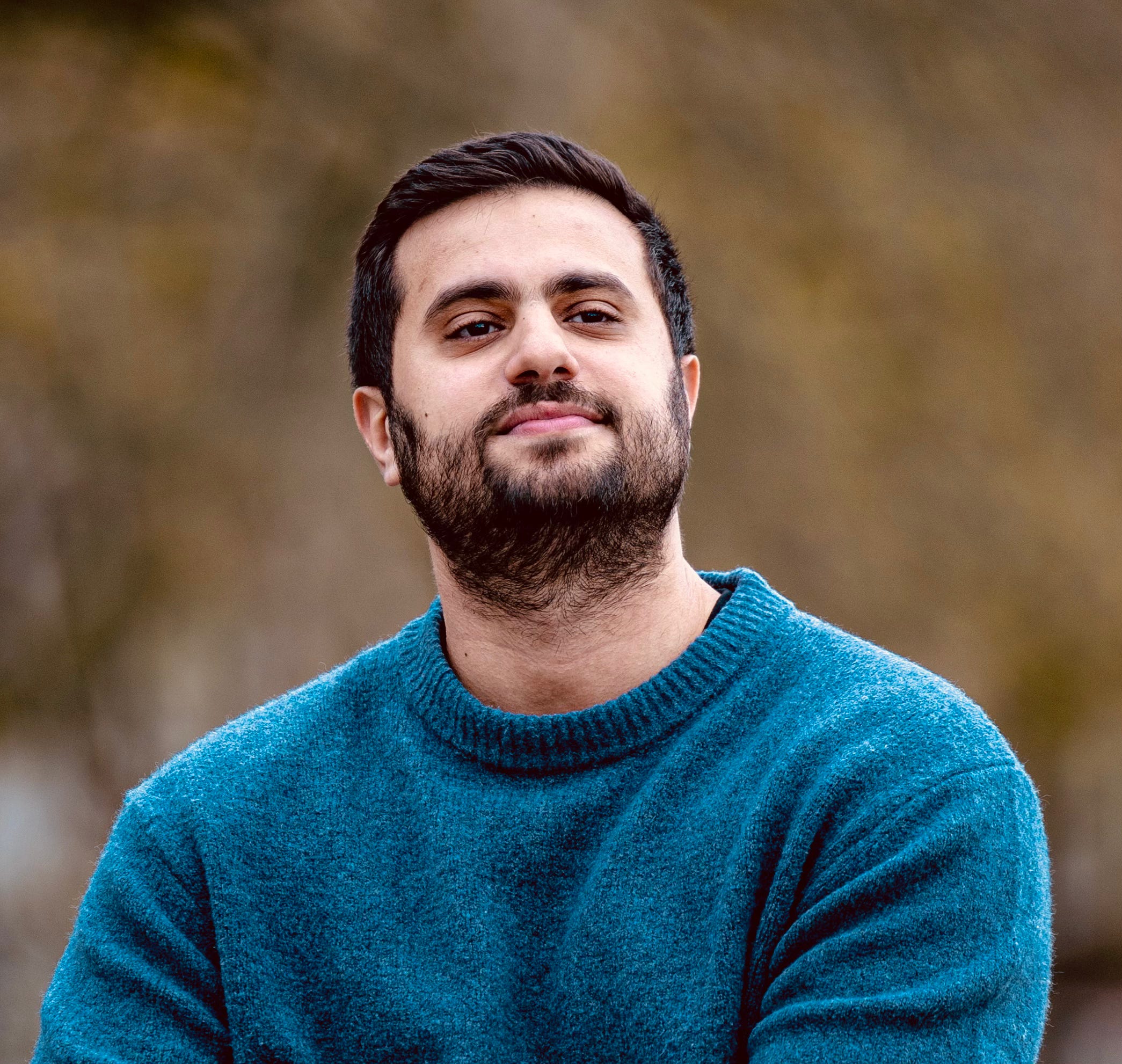
Greetings, Abdelrahman. Before we get into your stunning personal story, let’s have a brief historical refresher. Walk us through the basics of the 2011 revolution in Egypt, when you were fifteen.
We’d had a military dictatorship in Egypt ever since the overthrow of the monarchy in 1952. The 2011 revolution happened because of corruption and police brutality, and the catalyst was one major instance of police brutality—the fatal beating of Khaled Said, which went viral on social media. The revolution included millions of people from across ideologies and social classes in Egypt.
Who then took over in Egypt?
When the first democratic elections were held, the Muslim Brotherhood happened to be one of the most organized groups, so it took over. But there was a lot of debate and tension about the Muslim Brotherhood—because of its conservatism, because it had collaborated with the military during the revolution, and ultimately because it failed miserably at running the country.
The Muslim brotherhood was able to hold things together for roughly a year. And eventually people started taking to the streets again, calling for early elections. We witnessed this weird situation, where police officers were hoisted on shoulders and the military were hailed as saviors, and eventually the military coup retook the country in the summer of 2013.
When the military coup retook the country, you were seventeen. Where did you and your family align politically at the time?
Like most lower-middle-class and middle-class families in Egypt, my family had been very apolitical. It’s unsafe to be political in Egypt. Being political is associated with prisons, and that was even more true following the 2013 military coup. During the old military dictatorship, repression was targeted. But now, after what happened in 2011, they’d learned that you cannot be lenient, cannot allow even an inch of breath. So repression no longer discriminated. Suddenly you could go to prison for writing a tweet. That said, my family had supported the revolution, and did become more politically conscious during those years, if only at home—watching TV, cheering for the revolutionaries.
But after the military coup, you were drawn out of the home and into the streets, in part because of a girl you liked. What exactly happened that led to your political awakening?
I had met this girl, Nada, through Cairo Runners, which became a group in the time after the revolution. They started running every Friday, and I had a little crush on her. Then the military dictatorship retook the country in July of 2013, returning Egypt to what it had always been, but much worse. In August, the month after the military coup, the Rab’a Massacre happened. Some accounts say up to 2,000 people were massacred, and Nada’s father was one of the people who were killed.
At the time, I was seventeen. I went to a very humble Arabic school. In Egypt, knowing English is a class thing—it’s the way toward upward mobility. I wanted to get on that track, but that was not the track I was on at the time. I got good grades. But I wasn’t thinking about my future as critically as I would be now. I was a teenager. I wanted to play basketball in the U.S. I had all these basketball dreams. I hoped for a scholarship. That was my headspace at the time.
When Nada’s father was killed at Rab’a, I wasn’t yet fully mobilized, or activated, politically. But then I saw how her father’s death broke her apart. Nada used to be this very bright person who was full of life and joy. Seeing her broken had a very deep effect on me. When I attended her father’s funeral, I joined thousands of people at the mosque. Afterward, outside, everyone who emerged from the funeral formed this impromptu protest. That was my political awakening. After that, I started attending protests—excessively, sometimes three a day.
Then October 6, 2013, rolled around. Take us through that fateful day.
In Egypt, October 6th is Armed Forces Day. It’s a national holiday. So that day there was a major protest against the military coup. I wanted to attend. But it was happening in Ramses, which is close to Tahrir Square, the site of the 2011 revolution. Following 2011, anywhere near Tahrir was a very risky place to be. So my parents were really wary about me going to that protest. It was a hard “no” from them. But it just meant so much to me to be at that protest, and I was hotheaded about it, being seventeen. So a compromise was offered: My father was going to visit his mother, my grandma, that day, so we agreed that I’d come along, and that, on the way, my father would basically chaperone me through the protest.
Chaperone you?
I resisted at first. I mean, what kind of revolutionary gets chaperoned? But it was better than not going at all. My father was not happy about it. But he agreed to basically protect me, for maybe fifteen minutes, so I could feel like my conscience was cleared, and then we would go on from there to my grandmother’s house.
When we got to Ramses, I started shooting a video from the car window, as we were approaching the protesters. In Egypt, we have a lot of plainclothes officers. I didn’t know that the two men standing right next to the car were police. They opened the car door, got me out, and beat the shit out of me. And that’s when the arrest happened—the inciting incident, I guess.
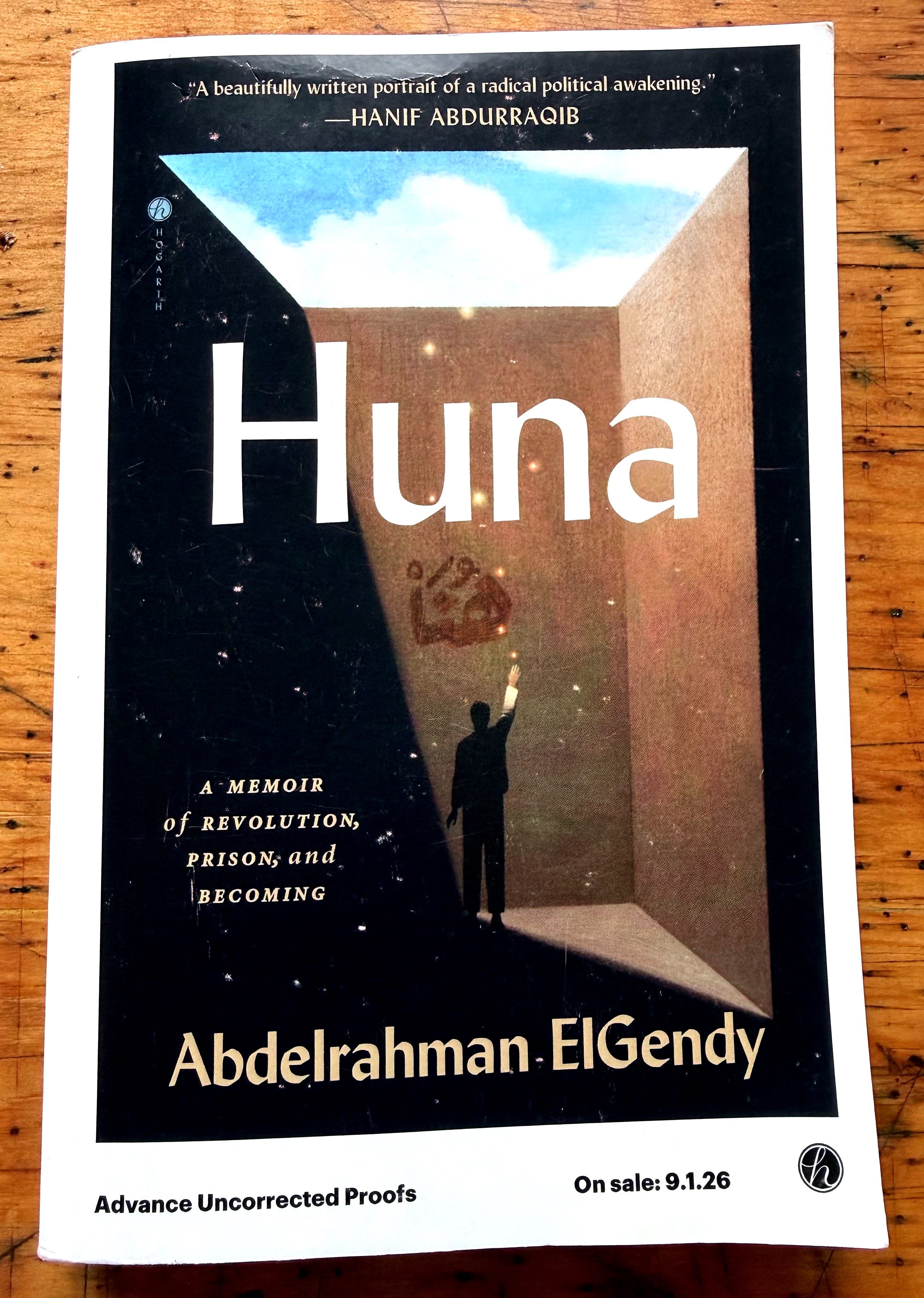
In Huna, you write about the tremendous guilt you felt, as the responsible party for not just your own incarceration but that of your father. After all, he’d spent his life specifically avoiding such a fate. And now, in his fifties, he was contending with health challenges that made imprisonment a grueling ordeal. To make things worse, when you two were in the system, there was only so much you could do for one another. Attempts to help the other person could backfire. For instance, he wanted to keep you out of the juvenile system, with its reputation for sexual assault, so he instructed you to withhold the fact that you were a seventeen-year-old minor. Doing so, however, prolonged your prison term. Because you were then tried as an adult and sentenced to 15 years, whereas minors got ten years.
Yes. In the end, my dad served three years, and I served six years and three months.
What did all of this mean for your relationship with your dad?
It was fascinating. Not fascinating. But…it did something to me—to witness my father as something else, something that is not my father: an inmate. In this setting, he was just an inmate, and the relationship of him being my father did not matter to anyone—not to cellmates, not to jailers, not to police. And that does something to a person. It breaks you to witness your father being subjected to violence, beaten by guards, ridiculed by other prisoners, and you are unable to intervene.
At first, I intervened. I punched people and fought. But there were things you just cannot do. Like, if we’re being tortured, what are you gonna do? It’s sadistic. If I try to do something, they would not hurt me, but they would hurt him more in order to hurt me. And on top of all that, knowing I’m the reason he’s there in the first place, that was the most complicated thing.
But there was also some light, it seemed. Prior to prison, you say you had an inability to express affection, particularly toward your family, but prison changed that.
Prison puts things in perspective. For example, being in a prison is a very compelling reason to hug your family members when you see them. My father and I had to split five-minute visitation periods into 2.5 minutes each. We would fight because he took up 30 seconds more out of my time with my mother. It really gets you thinking about the value of every second you get with your loved ones. Now, every time we hug, we remember that we were deprived of that ability for such a long time. Don’t get me wrong. Prison was ruinous for us. Prison meant my family had to sell its house. But I think prison also mended much of the fracture between me and my family. It allowed us to be more comfortable and warm to one another.
It’s complicated. I believe in what I stood for, what I fought for, but it’s also true that my family was shattered. And in the book I wanted to hold that tension. Huna intentionally shies away from things like resilience and resistance, or some heroic narrative portrayal.
Heroism aside, education, and writing itself, are major themes of Huna. In prison, you got an engineering degree. And reading the work of an Egyptian writer inspired your own writing.
Radwa Ashour was one of the most brilliant, accomplished writers in Egypt. In prison, I started reading her fiction, the Granada trilogy. And then I read her memoir, Heavier than Radwa, about the revolution and her battle with cancer, which eventually took her life in 2014. Literary memoir is not a popular genre in Arabic. And I just kind of fell in love with the way she was approaching the idea of the personal and the intimate being entryways into the political.
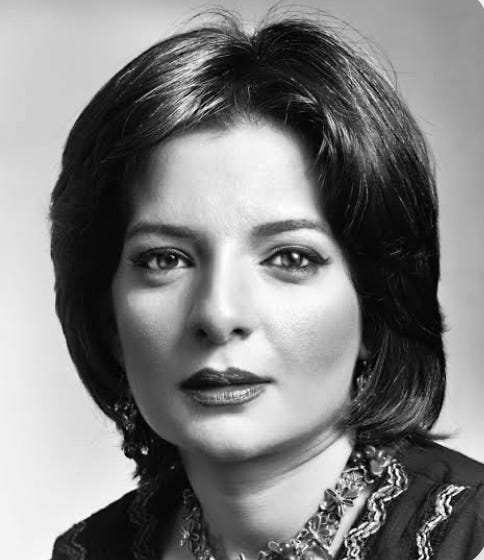
I read her memoir, and started thinking: If I’m ever out of prison, I’d like to turn these scenes that I’m living into a book. And I discovered that writing helped me survive. If I was being beaten by a guard, a way for me to cope with that was to think, ‘This is gonna be such a great scene in a memoir. How am I gonna depict it?’ You detach from your body: It’s not happening to me. It’s happening to the protagonist of the memoir.
These are not experiences that one heals from quickly, if at all. How are you doing these days? How are you feeling?
I’m still recovering. The damage that I did to myself in prison, in order to survive, is not easily reversible. Things like tenderness, softness, vulnerability, the ability to hold and be held—these are the things that prison is built to destroy in us. And if you don’t kill enough of yourself, prison’s going to crush you. The page allowed me to retain some vulnerability, and a capacity for wonder and curiosity about the world and the people around me.
Huna is the record of your survival, but the book is also survival itself.
Yes, exactly. That’s how I describe it: Huna isn’t about how I survived. It’s how I survived.
After you got out, you kept writing, publishing articles with the Egyptian newspaper Mada Masr, and eventually you landed in Pennsylvania, at the University of Pittsburgh, for a MFA program in nonfiction writing. What was it like to come to the U.S.?
It was a fully-funded three-year program, so at last I had some stability, and I used it to work on my book. I felt like I couldn’t move forward with my life without getting that book out of me.
Mission accomplished, and with a wonderful publisher. But then you had to leave the U.S. in the spring of 2025.
Because I was fearing ICE targeting. At that point, I was living exactly the same kinds of emotions that forced me to flee Egypt. I felt unsafe to write, to express myself, to protest.
And you knew you had this book coming out here, eventually.
Yeah, so leaving the States was a huge loss. Everyone dreams of the day they publish a book and go on tour and share physical spaces with readers. I would never have given that dream away if I didn’t believe there was a very likely possibility of me being arrested. The stakes are high. If I am arrested in the U.S. and deported to Egypt, I’d probably land in prison, especially now, with a book like this out. They arrest people for far less. They’d probably arrest me at the airport.
Egypt is not something people talk about anymore. It’s no longer sexy repression. Most people have no idea that we have 60,000 political prisoners under this brutal dictatorship. People are just kidnapped off the street, and their families have no closure. I would love to live in Egypt. But I need to live in places where I can speak, write, and act freely.
You’re now living in Amsterdam. Is that where you hope to stay?
Yes. I work as an editor here at the Markaz Review, a literary journal. And I enjoy the slower pace of life in Amsterdam. In the U.S., people are intense. Everyone is moving, you know, toward something. Here, I write by the canals, and people are very chill. I love it.
Thanks for this. A very moving interview. And the reference to ICE is terrifying. I will definitely order Abdelrahman AlGendy's book.